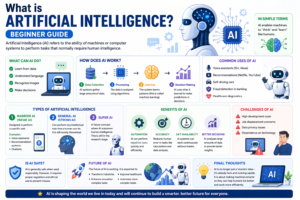
What is Artificial Intelligence? Beginner Guide
Artificial Intelligence (AI) is one of the most talked-about technologies in today’s world. From smartphones to smart homes, AI is shaping how we live, work, and interact with technology.
But what exactly is Artificial Intelligence? Let’s break it down in a simple and beginner-friendly way.
What is Artificial Intelligence?
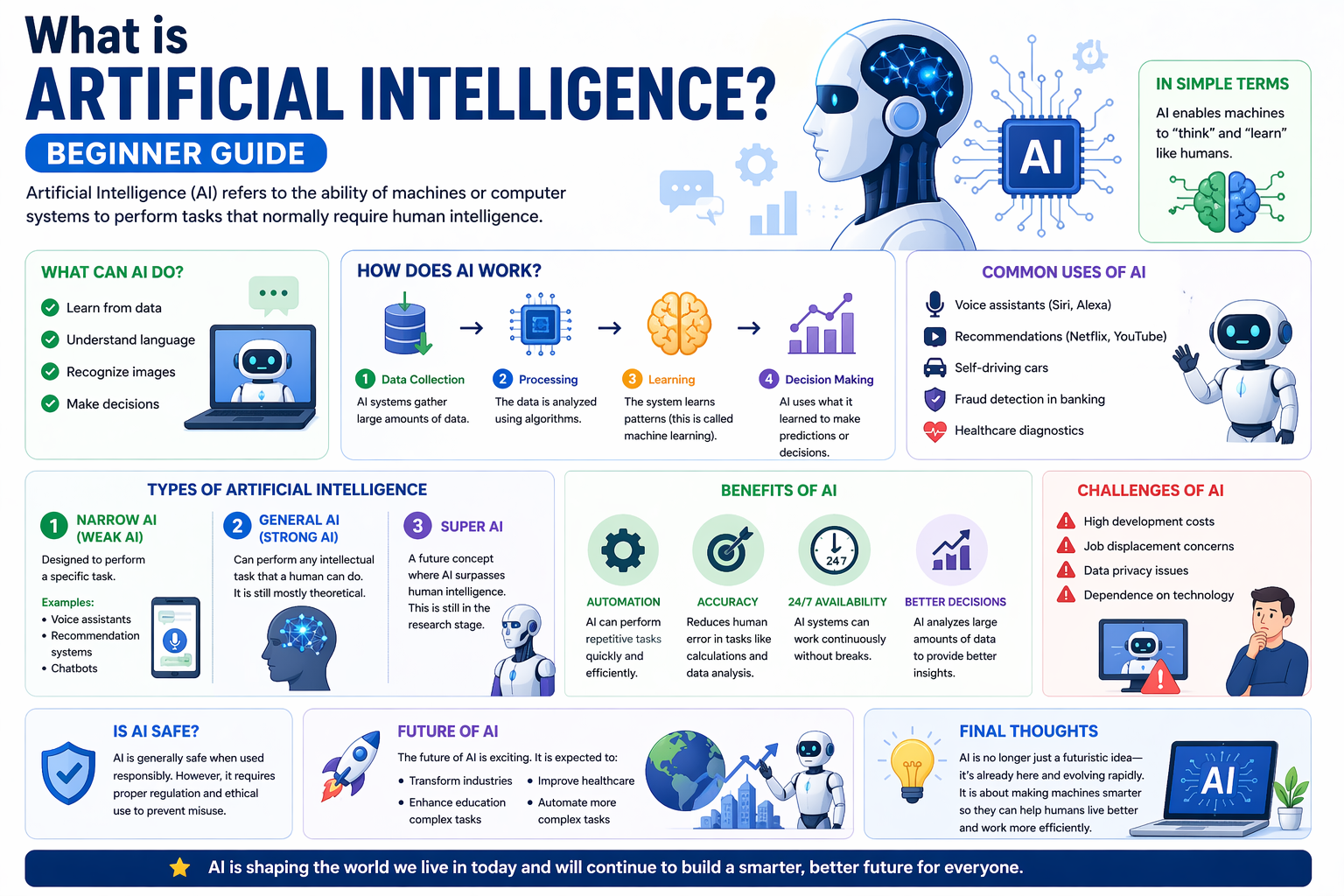
Artificial Intelligence (AI) refers to the ability of machines or computer systems to perform tasks that normally require human intelligence.
These tasks include:
- Learning from data
- Understanding language
- Recognizing images
- Making decisions
In simple terms:
AI enables machines to “think” and “learn” like humans.
How Does AI Work?
AI works by using data, algorithms, and computing power to identify patterns and make decisions.
Here’s a simple breakdown:
- Data Collection – AI systems gather large amounts of data
- Processing – The data is analyzed using algorithms
- Learning – The system learns patterns (this is called machine learning)
- Decision Making – AI uses what it learned to make predictions or decisions
Types of Artificial Intelligence
1. Narrow AI (Weak AI)
This is the most common type of AI today. It is designed to perform a specific task.
Examples:
- Voice assistants
- Recommendation systems
- Chatbots
2. General AI (Strong AI)
This type of AI can perform any intellectual task that a human can do. It is still mostly theoretical.
3. Super AI
A future concept where AI surpasses human intelligence. This is still in the research stage.
Common Uses of AI
AI is already part of our daily lives:
- Voice assistants like Siri and Alexa
- Recommendation systems on Netflix and YouTube
- Self-driving cars
- Fraud detection in banking
- Healthcare diagnostics
Benefits of Artificial Intelligence
1. Automation
AI can perform repetitive tasks quickly and efficiently.
2. Accuracy
Reduces human error in tasks like calculations and data analysis.
3. 24/7 Availability
AI systems can work continuously without breaks.
4. Improved Decision Making
AI analyzes large amounts of data to provide better insights.
Challenges of AI
- High development costs
- Job displacement concerns
- Data privacy issues
- Dependence on technology
Is AI Safe?
AI is generally safe when used responsibly. However, it requires proper regulation and ethical use to prevent misuse.
Future of Artificial Intelligence
The future of AI is exciting. It is expected to:
- Transform industries
- Improve healthcare
- Enhance education
- Automate more complex tasks
AI will continue to grow and become a bigger part of our everyday lives.
Final Thoughts
Artificial Intelligence is no longer just a futuristic idea—it’s already here and evolving rapidly.
Whether you’re using a smartphone, browsing the internet, or watching videos online, AI is working behind the scenes.
In simple words:
AI is about making machines smarter so they can help humans live better and work more efficiently.










Post Comment